
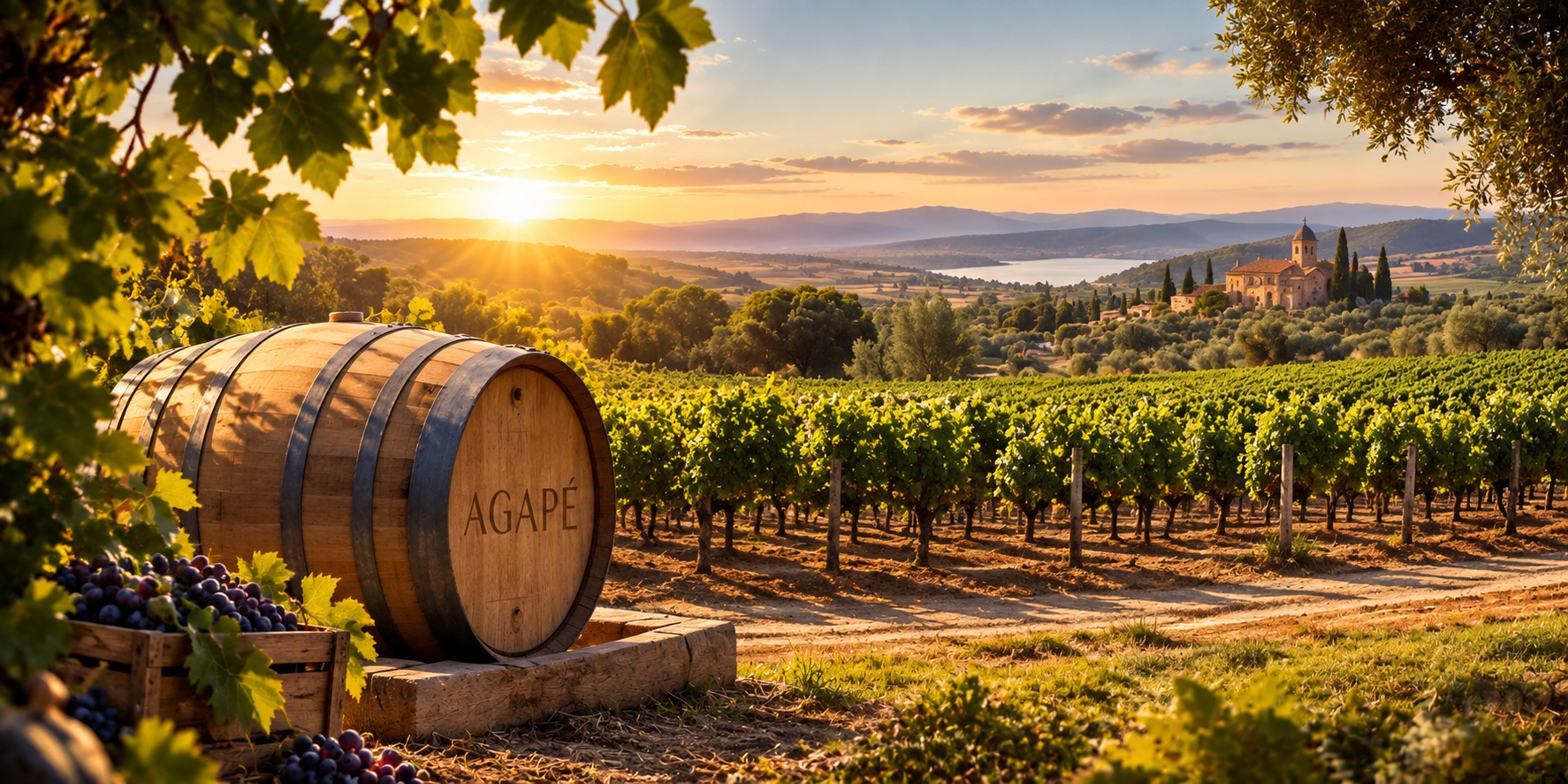
Wine, Land, Time and the Human Story
Before wine has a name, a label, or a place at the table, it begins quietly.
It begins beneath our feet.
In soil warmed by the sun. In roots reaching deep into the earth. In winter rain, in spring growth, in the heat of summer, and in the patience of a vineyard waiting for the moment when its fruit is ready to be gathered.
Wine begins long before the bottle.
Perhaps this is why wine has accompanied humanity for thousands of years. It is not simply something we make. It is something we wait for.
A farmer can plant a vine, tend it, prune it and protect it. He can walk through the vineyard at sunrise and examine the fruit with his own hands. He can watch the seasons change and learn to recognize the smallest signs of readiness.
But he cannot command the vine to bear fruit.
He cannot command the rain to fall.
He cannot hurry the seasons.
There is humility in wine.
The Earth Gives. Human Hands Continue the Story.
Every bottle carries a meeting between nature and humanity.
- The soil gives character.
- The sun gives warmth.
- The rain gives life.
- The vine gives fruit.
And then human hands take responsibility for what has been given.
The grapes are harvested. Crushed. Fermented. Watched carefully. Allowed to rest.
And then comes perhaps the most difficult ingredient of all:
time.
Wine teaches us something our modern world often tries to forget — that not everything valuable can be rushed.
Some things must be allowed to become.
There is something almost spiritual in that idea.
Faith, too, grows over time. Love deepens through experience. Hope survives seasons of uncertainty.
And a vine does not bear its finest fruit the day it is planted.
Wine in the Land of the Bible
For the peoples of the biblical world, the vineyard was not an exotic image.
It was part of life.
People knew the smell of the earth, the work of harvest, the sweetness of ripe grapes and the joy of wine shared at a table.
That is why Scripture so naturally speaks through the language of vineyards, vines, branches, fruit and wine.
These were not abstract theological metaphors to the first listeners.
They were things people could see, touch, smell and taste.
The vineyard was outside the village.
The vine grew beside the home.
Wine was poured at the table.
When Scripture spoke of the vineyard, people understood the patience it required. When Jesus spoke of the vine and its branches, they understood that a branch separated from its source could not live.
Wine belonged simultaneously to the earth and to human experience.
And Christianity would give it an even deeper meaning.
A Gift and the Work of Human Hands
The Catholic tradition beautifully preserves this relationship during the Eucharistic liturgy.
Wine is described as the “fruit of the vine and work of human hands.”
That sentence contains an entire philosophy.
The vine is given.
The fruit grows.
But human beings are invited to participate — to cultivate, harvest, transform and offer.
Creation and human work meet.
The earth gives us something, and we are asked what we will do with what we have received.
Perhaps that is one reason wine has carried such profound meaning across generations.
- A glass of wine can contain a season.
- A vineyard.
- A harvest.
- The hands of people who worked the land.
- Years of patience.
- A place.
- A memory.
And sometimes, a story far greater than the wine itself.
For Shepherds of Faith, wine is therefore not simply what is inside the bottle.
It is a connection.
Between land and people.
Between past and present.
Between what we receive and what we choose to create from it.
And ultimately, between the physical world we can touch and the mysteries we choose to believe.
From the earth.
Through human hands.
Across time.
With Faith. With Hope. With Love.