
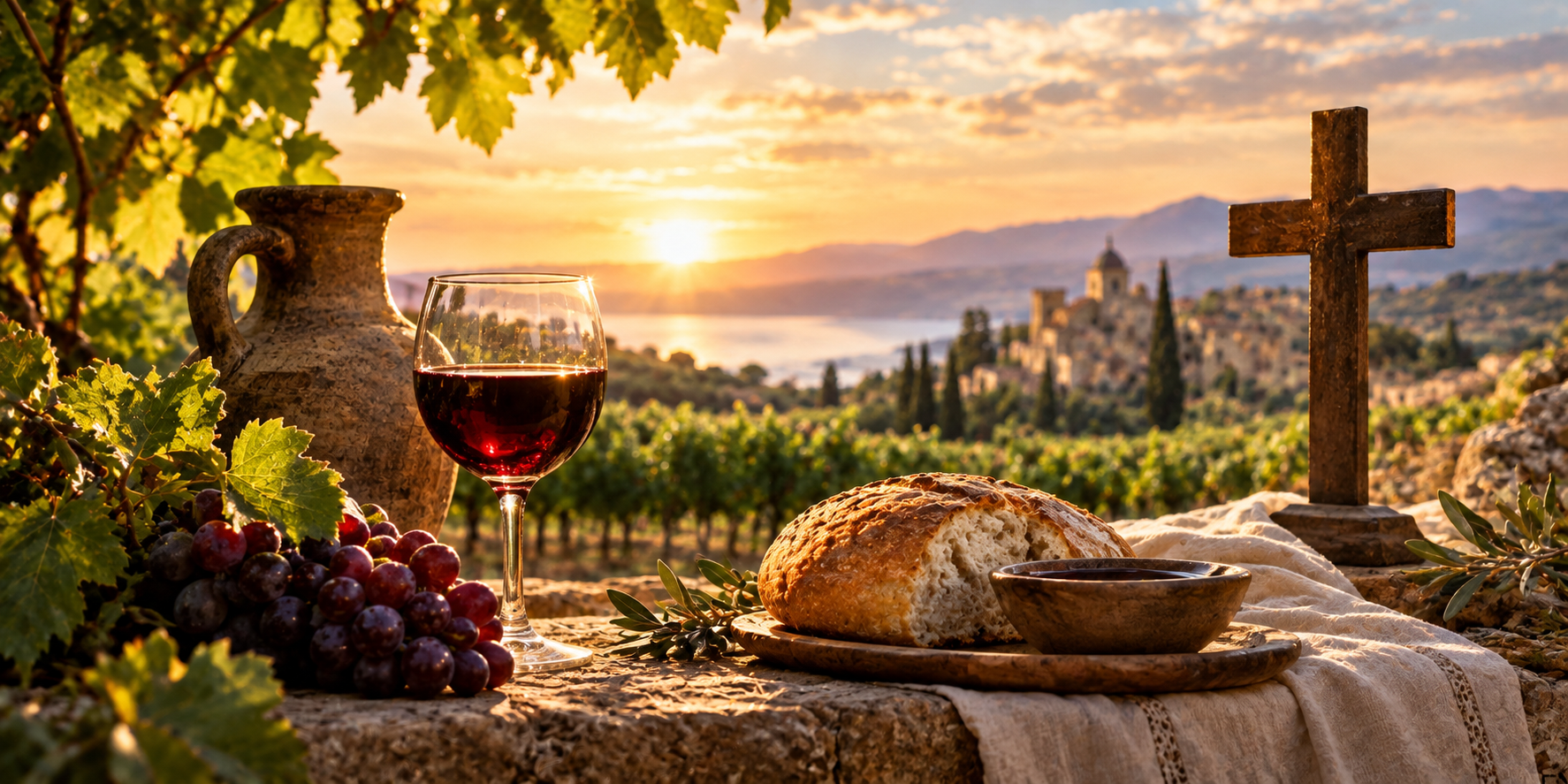
From the Vine to the Eucharist
Why Wine Holds Such a Profound Place in Christian Faith
Imagine walking through a vineyard in the land of the Bible.
The afternoon sun falls gently across rows of vines. The earth is warm beneath your feet. You reach toward a branch and hold a cluster of grapes in your hand, the fruit still carrying the warmth of the day.
For us, it may simply be a beautiful scene. But for the people who first heard the words of Scripture, the vineyard was not merely a poetic image. It was part of everyday life. They knew the seasons of the vine, the labor of the harvest, the sweetness of ripe grapes and the joy of wine shared around a table.
This helps us understand why the imagery of the vine, the vineyard, fruit and wine appears so powerfully throughout the Bible.
Wine is associated with celebration, abundance and joy. The vineyard becomes an image through which Scripture speaks about blessing, responsibility, covenant and the relationship between God and His people.
But in the New Testament, these familiar images begin to reveal something even deeper.
“I Am the True Vine”
In the Gospel of John, Jesus says:
“I am the true vine.” — John 15:1
It is a remarkably simple image carrying an extraordinary spiritual meaning.
A branch may appear alive for a time after it has been separated from the vine, but without its source it cannot continue to grow or bear fruit. Jesus takes something His listeners understood from the world around them and uses it to reveal something they cannot see with their eyes.
Our spiritual lives are not meant to exist independently of their source.
Faith, in this sense, is much more than accepting a collection of ideas. Faith is relationship. Faith is connection. Faith is remaining.
It is allowing life to flow from the source into the branch until, in time, that life bears fruit.
Later in the same passage, Jesus makes the image even more personal:
“I am the vine; you are the branches.” — John 15:5
Suddenly, the vineyard is no longer simply agricultural land. It becomes a way of understanding the Christian life itself.
The vine is the source. We are the branches. And the fruit we bear depends upon remaining connected to Him.
From the Vineyard to the Table
The story of wine in Christianity does not end among the vines.
Eventually, it leads us to a table.
On the night before His Passion, Jesus gathers with His disciples for the Last Supper. Imagine the intimacy of that moment: people who had walked together, eaten together, listened, questioned, believed and sometimes failed to understand.
On the table are two of the most ordinary foods of their world:
bread and wine.
Yet within that meal, the ordinary becomes sacred.
Jesus takes the bread. He takes the cup. And He gives them a meaning that will remain at the heart of Christian worship for generations to come.
For Catholic Christianity, the Eucharist is not simply a historical reenactment of the Last Supper, nor is the bread and wine merely poetic imagery. The Church teaches that through the Eucharistic celebration, by the words of Christ and the invocation of the Holy Spirit, the bread and wine become the Body and Blood of Christ.
And so something extraordinary happens to the meaning of wine.
What began in the earth, grew upon a vine, ripened beneath the sun and was harvested by human hands enters into the heart of Christian worship.
The journey is almost breathtaking when we consider it:
Earth. Vine. Grape. Human hands. Wine. Table. Eucharist.
The physical and the spiritual meet.
When Earth and Heaven Meet at the Table
There is something profoundly beautiful about Christianity’s relationship with the material world.
Christian faith does not teach us that physical creation is meaningless.
On the contrary, throughout Scripture, God repeatedly uses the ordinary and familiar to reveal something greater.
Water matters.
Bread matters.
Wine matters.
Oil matters.
The human body matters.
A meal matters.
A wedding matters.
Creation can carry meaning.
The visible can lead us toward the invisible.
And perhaps this is one of the most moving aspects of Christian faith: God meets humanity through things we can understand with our senses.
Things we can see.
Things we can touch.
Things we can smell.
Things we can taste.
A person can stand in a vineyard and feel the soil beneath his feet. He can touch the vine. He can taste its fruit. He can pour wine into a glass.
And through these tangible things, Scripture invites us to contemplate mysteries far greater than what our senses alone can perceive.
The ordinary becomes a doorway to the extraordinary.
The Vine, the Branches and Us
Return once more to the image Jesus gave His disciples:
“I am the vine; you are the branches.”
There is something deeply humbling about a branch.
A branch does not create its own life.
It does not decide that it no longer needs the vine.
Its strength comes from remaining connected to its source. Its fruit becomes possible because life continues to flow through it.
Perhaps that is why the vineyard remains such a powerful image for faith.
It reminds us that we do not walk alone.
That love requires connection.
That faith requires trust.
And that hope sometimes means remaining connected even when we cannot yet see the fruit.
Anyone who understands the vineyard understands this.
There are seasons of abundance, when the branches are heavy with fruit. But there are also seasons when the vineyard appears almost empty.
Winter comes.
The leaves fall.
The branches become bare.
To someone who does not understand the vine, it may appear that life has disappeared.
But beneath the surface, the vine is still alive.
The roots remain in the earth.
Life is still there.
It is simply waiting for its season.
There is something profoundly Christian in that image.
There are moments in life when we see the fruit of our faith, and moments when we do not. There are times of certainty and times of questions. Times of joy and times of suffering. Times when God’s presence feels close and times when we are asked simply to trust.
Winter does not mean the vine is dead.
Sometimes life is quietly preparing beneath the surface.
That is faith.
That is hope.
And when the first new leaves eventually appear, we understand that the waiting was not empty.
More Than Wine
For Shepherds of Faith, these ideas are not simply decoration added to a bottle or a story created around wine.
They belong to a much older story.
The story of the land.
The vine.
The vineyard.
The biblical world.
The table.
The people who gather around it.
And the belief that something physical can carry memory, meaning and a connection to something greater than ourselves.
When we hold a glass of wine, therefore, perhaps we can pause for a moment before tasting it.
We can remember where it began.
The earth beneath the vineyard.
The roots hidden beneath the soil.
The sun and rain.
The changing seasons.
The hands that cared for the vines.
The people who gathered the grapes.
The patience required to transform fruit into wine.
And beyond all of that, we can remember a story of faith that has traveled across lands, cultures and generations.
A story in which the vine became an image of connection.
A story in which wine found its place at a sacred table.
A story in which something born from the earth became part of the language through which humanity encounters the divine.
Perhaps that is why wine holds such a profound place in Christian faith.
Because sometimes, what appears to be simply fruit of the vine can invite us to look beyond what is in the glass.
Toward the land.
Toward the story.
Toward one another.
And ultimately, toward the Source.
Land. Vine. Faith.
From the land where the story began.
SHEPHERDS OF FAITH
With Faith. With Hope. With Love.